

how to draw a phylogenetic tree

To amend understand what a phylogeny represents, commencement past imagining one generation of collywobbles of a detail species living the aforementioned expanse and producing offspring. If you focus on iv individual butterflies in both the parental and offspring generations, the resulting pedigree may appear like the one in Figure 1B.
Now, expand your image to encompass all the butterflies of this species in a item meadow over several generations. A full-blooded for this population might look something like the one in Figure 1C. Note that each private in the figure has two parents, but each gives ascension to a variable number of offspring in the next generation.
Next, imagine taking your pedigree and getting rid of the organisms, thus keeping but the descent relationships, which are the glue that holds the population together (Figure 1D inset box). Then zoom out even farther to include many more than individuals (say, from multiple meadows in the aforementioned region) and more generations. For instance, the whole of Effigy 1D is derived from a like diagram as the inset box, but information technology now includes more than individuals and many generations. Every bit you tin see, if one were to try to stand for a typical population of several chiliad individuals that persists for hundreds or thousands of generations, all one would meet would be a fuzzy line.
Private populations may be fairly isolated for some period of time. However, on an evolutionary timescale, migration volition occur amongst the detached populations that brand up a typical species. This gene period betwixt populations has the outcome of "braiding" the population lineages into a single species lineage, which might be thought of equally resembling Figure 1E.
Moreover, during evolution, lineages ofttimes split up. This occurs when populations or groups of populations become genetically isolated from one another. Lineages most commonly divide because of the migration of a few individuals to a new, isolated region (eastward.1000., an island). This is sometimes called a founder event. Alternatively, a formerly contiguous range can be broken up by geological or climatic events (due east.g., the creation of mountains, rivers, or patches of inhospitable terrain). This miracle is chosen vicariance. No matter whether populations split due to founder events or vicariance, if the isolated populations remain separate, they will start evolving differences from one some other (Figure 1F). After all, a mutation that arises in i population will have no style to get to the other population. Thus, fifty-fifty a mutation that would be selectively favored in both populations will become fixed in only i of the groups.
As a issue of this genetic isolation, the lineages will evolve separately, becoming more than and more different over time. If they remain autonomously for long periods, enough physiological and behavioral differences may evolve to result in reproductive isolation, such that information technology volition be impossible for individuals from the 2 lineages to reproduce even in the case that they do come up back into contact. Considering of this, it is a useful simplification to assume that once lineages diverge, the ii sets of descendants volition remain distinct.
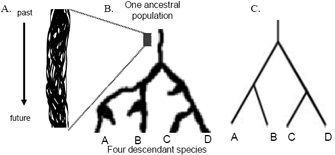
Figure 2B shows what we might see if nosotros followed the fate of a single ancestral lineage (Figure 2A) long enough that it gave rising to 4 descendant lineages (species). This example includes three lineages that were established but became extinct before the end of the observation menstruation. This diagram is an example of a uncomplicated phylogenetic tree.
In most cases, researchers draw phylogenetic trees in such a way equally to record but those events that are relevant to a set of living taxa. Almost usually, these taxa are species. For case, Figure 2C shows the bones tree we could draw to stand for the history of the four "tip" species, A through D. This tree shows that species A and B share a more than recent mutual ancestor with each other than with either species C or species D. Likewise, species C and D share a more contempo common antecedent with each other than with either species A or species B. This instance illustrates the fact that a phylogeny is, at its virtually basic level, a history of descent from common beginnings.
Phylogenetic copse are fractal in the sense that the aforementioned pattern is establish whether we consider recently diverged lineages or deep splits in the tree of life. Indeed, the most basic postulate of evolutionary theory is that the aforementioned full general phenomenon of descent from common ancestry applies to both the nigh various branches of the tree of life and the well-nigh similar. Equally a consequence, the tree construction is extremely helpful in tracking biological diversity at all levels.

Source: http://www.nature.com/scitable/topicpage/reading-a-phylogenetic-tree-the-meaning-of-41956
Posted by: milleryoublituff.blogspot.com
0 Response to "how to draw a phylogenetic tree"
Post a Comment